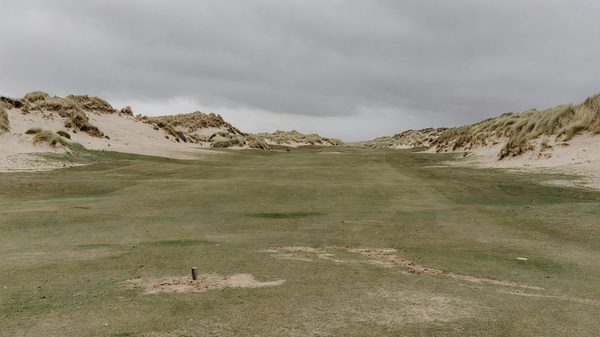
The Amgen Irish Open is played at Trump International Golf Links & Hotel in Doonbeg, County Clare, from Thursday 10 to Sunday 13 September 2026. It is the first time the tournament has visited this course, and it lands in a September slot on the DP World Tour calendar rather than the high-summer date the Irish Open occupied for much of the last decade.
For anyone planning a trip around it, that combination — new venue, autumn date, remote Atlantic location — changes the practical calculus considerably compared with a K Club or Royal County Down year.
Where Doonbeg actually is
This is the first thing to sort out, because it governs everything else. Doonbeg is a village on the west Clare coast, on the Wild Atlantic Way, roughly 40 minutes southwest of Ennis and about an hour from Shannon Airport. Shannon is the practical arrival point: it takes direct transatlantic and UK traffic, and it is far closer than Dublin, which is a three-and-a-half-hour drive away on the other side of the country.
The Cliffs of Moher sit about 40 minutes north, and Lahinch — one of Ireland’s great championship links and host of the 2019 Irish Open — is 25 minutes up the coast. That proximity is the argument for building a week around this rather than a long weekend.
Accommodation is the constraint. West Clare is rural, the on-site hotel at Trump International will be committed to tournament operations and hospitality, and the surrounding villages have limited bed stock. Ennis, Lahinch, Kilkee, and Kilrush are the realistic bases, and by this point in the calendar the good options in all four will be thin. If you have not booked, treat that as the first task rather than the last.
The course
The links was designed by Greg Norman and opened in 2002 on a stretch of dunes that had been identified as golf country for a century before anyone built on it. After the property changed hands in 2014, the architect Martin Hawtree carried out a substantial two-year redesign — re-routing several holes and rebuilding all eighteen of Norman’s greens, along with new bunkering and recontouring.
It plays to a par of 72 at 7,026 yards from the back tees, in a single loop of nine out and nine back. The routing has an unusual balance: five par 3s and five par 5s, which is a distribution you almost never see and which gives the card a different rhythm from a conventional links. The Atlantic is visible from sixteen of the eighteen holes.
What this means for tournament week is that scoring will be wind-dependent to an unusual degree. A links with five short holes and five par 5s offers a lot of birdie opportunity in benign conditions and becomes brutal when the wind gets up off the Atlantic, which in September it frequently does. Do not expect the same winning score in calm and rough weather; this is not a course that produces a predictable number.
Watching it
Doonbeg’s dune topography is genuinely good for spectating. Links land with elevation gives natural vantage points that a flat parkland course cannot, and the out-and-back routing means the closing stretch and parts of the front nine are walkable within a compact area.
Tickets are sold through the DP World Tour, which handles general admission and hospitality packages. Sunday is the day that sells first.
Practical points specific to this venue:
- Weather-proof properly. September on the west Clare coast delivers all four seasons in an afternoon. Full waterproofs, not a showerproof layer. Wind is the constant, not the exception.
- Footwear matters more than usual. Dune-land spectating means sand, slopes, and long grass. Walking shoes with grip, not trainers.
- Plan the transport. Rural single-carriageway roads into a village hosting a Rolex-scale event. Use the official park-and-ride arrangements rather than improvising, and build in far more time than the map suggests.
- Cash and coverage. Mobile coverage on the west Clare coast is patchy in places. Do not rely on a phone-only ticket without a downloaded backup.
Playing it yourself
The course is open to visiting golfers, and this is the more interesting proposition for most readers of a golf travel site.
The green fee is at the top of the Irish market — peak summer tee times run around €375, with twilight rates and off-season pricing available. Play in the shoulder months and the number drops meaningfully. Resort guests get preferential access and pricing, which is the usual mechanism at destinations of this type.
The window immediately around a tournament is the one to avoid: the course closes to visitors for tournament preparation and the event itself, and conditioning in the weeks afterward is often affected by the infrastructure teardown. If you want to see it in tournament condition, book for late September or October — after the recovery, still inside a workable weather window, at shoulder-season rates.
A note on expectations: Doonbeg divided opinion sharply when it opened. The Norman routing drew criticism for greens that some considered too severe for the wind exposure, and the Hawtree work was substantially a response to that. Contemporary assessments are considerably warmer than the early ones. It is not Lahinch or Ballybunion in the estimation of most links purists, but it is a serious Atlantic links on outstanding land, and the redesign addressed the specific complaints rather than papering over them.
Building the week
The strongest version of this trip treats the Irish Open as an anchor rather than the whole plan. Within an hour’s drive you have Lahinch, Doonbeg itself, and the approach to Ballybunion across the Shannon estuary by the Tarbert–Killimer ferry, which cuts a long inland detour down to a twenty-minute crossing.
That gives a realistic itinerary: fly into Shannon, base in Lahinch or Ennis, play two or three links across the week, and spend tournament days at Doonbeg. It is a considerably better use of the airfare than four days of spectating alone — and in a September that also carries the BMW PGA Championship the following week at Wentworth, it is worth checking whether a wider European golf run makes sense before you book the return leg.